You're Not Just Buying Coaching Software. You're Choosing a Business Partner.
By Max Aita
A recent article published by Atlas, "Bring your own AI, or use the one they built in," makes the argument that coaching platforms with built-in AI are more expensive, more restrictive, and potentially less useful than platforms that allow coaches to bring their own AI.
"When AI is built into the plan, as it is at CoachLogik, it's priced in. Somebody pays for the model, the servers and the team that builds it, and that's the coach. You pay for it whether you use it every day or never open it once."
Atlas, "Bring your own AI, or use the one they built in" (November 16, 2026)
As the founder of CoachLogik, I think this argument fundamentally misunderstands the value of an integrated coaching platform, the direction technology is moving, and what coaches should expect from the companies they entrust with their businesses.
The conversation should be about much more than the cost of AI.
1.Integration Is the Entire Point
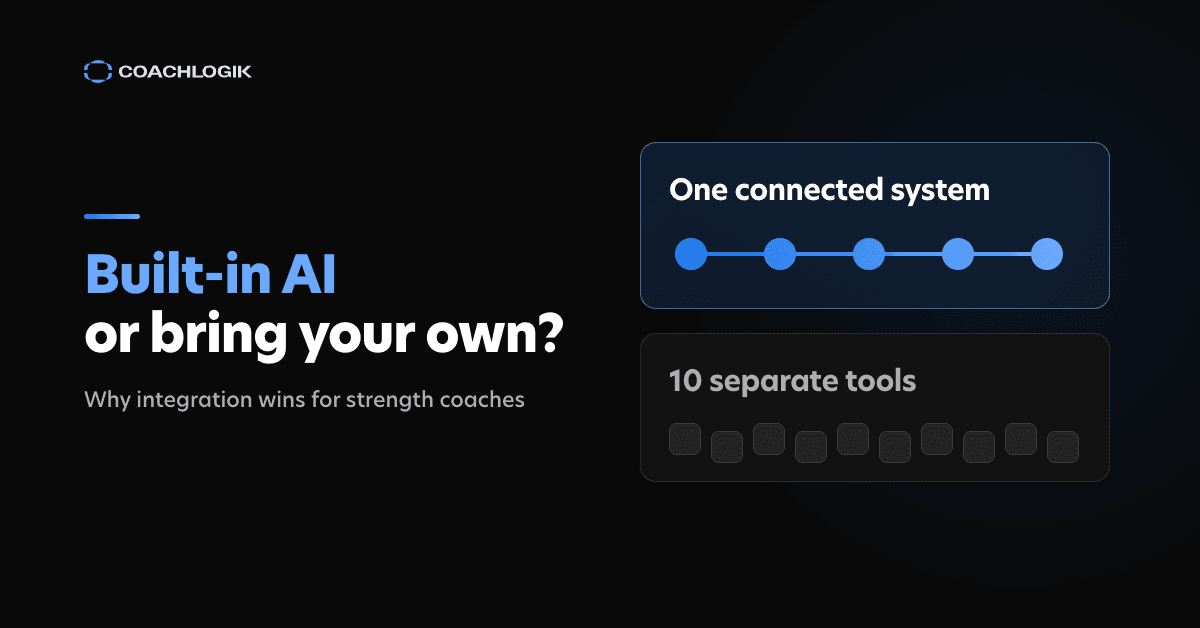
The reason you choose a coaching platform is that it solves multiple problems in one place. A system is a collection of interconnected solutions. The value of that system comes not only from what each individual feature does, but from how those features work together.
- We integrate programming and data tracking so coaches can use the results of past training to inform future training.
- We integrate video annotation so that feedback, videos, and training history are connected.
- We integrate messaging so that communication between athletes and coaches is preserved within the context of their training.
Why would AI be any different?
The entire purpose of building an interconnected ecosystem is to eliminate the need for coaches to move between different tools, transfer information, and maintain separate systems. Ironically, Atlas itself follows this philosophy with many of its other features. Yet when it comes to AI, it presents integration as a disadvantage.
There is certainly value in connecting external AI tools to coaching software. But external connectivity and built-in AI are not mutually exclusive. The goal should be to give coaches the most capable and seamless experience possible, not force them to assemble their own technology stack.
2.You're Paying for Features You Don't Use. That's How Software Works.
One of the central arguments in the Atlas article is that coaches using platforms with built-in AI are paying for something they may never use. Let's apply that logic to every other feature in a coaching platform.
- An athlete who never uploads videos is helping pay for the infrastructure used by athletes who upload every set.
- A coach who never uses video annotation is helping pay for its development.
- A coach with six athletes on a 15-athlete plan is paying for capacity they don't use.
- A coach who works alone is helping support features designed for organizations with multiple coaches.
In fact, Atlas advertises every feature on every plan, with paid plans supporting larger numbers of athletes. This is not a criticism of their pricing structure. It's a perfectly reasonable way to price software.
But it is a double standard to argue that bundling AI is a problem while applying the same pricing philosophy to everything else. If we follow that argument to its logical conclusion, every coach should be individually billed for every video uploaded, every message sent, every report generated, and every feature used.
That would be an absurd way to sell coaching software.
The question shouldn't be whether you use every feature you pay for.
The question should be whether the value you receive justifies the price.
See what one connected system feels like
Programming, data, video feedback, messaging and Copilot in one place. Try CoachLogik with your own athletes.
Start Free Trial3.AI Is Becoming a Utility
The counterargument to integrating AI into a coaching platform is that AI is expensive. There is a cost associated with every interaction. That's true. But it ignores the direction technology is moving.
We live and work in Silicon Valley. Anyone who has spent enough time in the technology industry understands one of its fundamental principles: technology tends to become cheaper as it becomes more capable.
AI is no exception.
According to Stanford University's 2025 AI Index Report, the cost of accessing AI with comparable GPT-3.5 benchmark performance fell from $20 per million tokens in November 2022 to just $0.07 in October 2024. That's a reduction of more than 280 times in less than two years.
As models become smarter, hardware becomes more efficient, competition increases, and infrastructure scales, the cost of delivering a given level of intelligence continues to fall. We believe AI will eventually become a utility, much like computing power, cloud storage, and internet bandwidth are today.
Coaches generally don't expect to be billed separately for every calculation a platform performs. They don't expect a separate invoice every time an athlete uploads a video or a coach runs an analytics report. These are simply the costs of operating a modern software platform.
Why would AI be any different?
Of course, AI costs need to be managed responsibly today. More powerful models and increased usage can still be expensive. But designing the long-term architecture of a coaching platform around the current cost of AI is shortsighted.
The future of software isn't less integration. It's more integration, made possible by increasingly affordable intelligence.
We are not building a platform around what AI costs today. We are building a platform around what AI will make possible tomorrow.
4.Access to AI Is Not the Same as Applied Intelligence
Giving a general-purpose AI access to your coaching platform is useful. But access to information is not the same as understanding how to use it.
A coach doesn't simply need an AI that can write sets and reps into a calendar. A coach needs a system that understands the relationships between programming, training history, exercise selection, athlete feedback, progression, and performance.
Consider the process of making a programming adjustment. A coach might need to review an athlete's recent videos, look at their performance over the last six weeks, review previous feedback, understand how they have responded to different exercises, and then make an informed decision about their next training block. The value of AI increases when all of those things are connected.
At CoachLogik, we are building our Copilot around the specific needs of strength coaches. Our objective is not to give coaches another chatbot. It is to build a system that understands their work and helps them execute their own coaching philosophy.
We want coaches to be able to teach the software how they coach. To establish their own methods, rules, and programming logic so that the system can help them apply those principles consistently across their athletes.
The coach makes the decisions. The software helps put those decisions into action.
There is tremendous value in having a team of developers and experienced coaches working together to solve these specific problems.
5.Profitability Is a Feature
One of the most overlooked aspects of choosing a coaching platform is the financial sustainability of the company behind it. Coaches should want the company they work with to make money.
Revenue and healthy margins allow companies to invest in:
- Dedicated developers.
- Customer service and technical support.
- Data security and reliable infrastructure.
- Bug fixes and quality assurance.
- Research and new features.
- Long-term product development.
None of these things are free.
An inexpensive platform might look attractive today. But what happens if the company cannot afford to maintain it tomorrow? What happens if the developer loses interest, takes another job, or simply becomes overwhelmed by the number of customers they need to support?
You have invested countless hours learning the platform, building programs, onboarding athletes, and creating a system for your business. You may have years of training data, thousands of videos, hundreds of programs, and an entire history of communication with your athletes stored in that system. If that platform disappears, the cost of moving your business could be many times greater than what you saved on your monthly subscription.
There is nothing inherently wrong with choosing a low-cost platform. And charging more does not automatically make a company more reliable. But price should never be considered independently of the company's ability to deliver a reliable service.
The price of software is not just the price of its features. It is also the price of keeping those features available, reliable, and improving for years to come.
Build your business on a platform built to last
A team of developers and coaches behind the product, and support when you need it. Start with your own athletes and see the difference.
Start Free Trial6.The Problem With the New Wave of Coaching Apps
For years, one of the biggest problems with coaching software has been the disconnect between the people building it and the people using it. Companies built features without understanding how experienced coaches worked. They failed to communicate with their users and were slow to solve the problems coaches actually had.
AI-assisted software development has created an exciting opportunity to change that. Individual developers and coaches can now build products that would have required entire engineering teams just a few years ago. That is a great thing for our industry.
But we also risk creating the opposite problem.
We now have individuals capable of building complex software without necessarily having the resources to operate, maintain, and support that software at scale. Building a product and running a software company are two very different things.
- When you have a technical problem, who is going to help you?
- When you need to learn how to use a feature, is there someone available to get on a call with you?
- When your business grows and you need additional functionality, who is going to listen?
- When something goes wrong and the only person responsible for fixing it is coaching at a competition or working another job, what happens to your business?
A solo developer can build an exceptional product. But as a business owner, you need to understand the risk of relying on a single individual for the infrastructure that supports your livelihood. These are not questions that can be answered by a list of features or a low monthly price.
The ability to build software has become increasingly accessible. The ability to build a sustainable organization that consistently serves its customers remains a much greater challenge.
7.You're Buying Into an Organization
A coaching platform is more than a collection of features. It is an organization that you are trusting with a significant part of your livelihood.
You should expect to communicate with that organization. You should be able to ask questions, get support, provide feedback, and influence how the product develops. You should expect the platform to become better as your business grows. And you should want the people behind it to be successful, because their success helps ensure the long-term stability of your own business.
That's the kind of relationship we want to build with coaches at CoachLogik. We believe that some of the best ideas for developing coaching software come directly from the coaches who use it every day.
The job of a software company is not simply to build features and sell subscriptions. It is to listen to its customers, understand their problems, and continuously improve the tools they depend on. That requires people. It requires time. It requires resources. And it requires a sustainable business.
We aren't simply trying to build software that coaches can use today. We are trying to build a company that coaches can depend on for the next ten years.
Think Beyond the Monthly Subscription
When choosing a coaching platform, don't simply ask which one is cheapest, which one has the most features, or which AI model it uses. Ask yourself:
- Who is behind this product?
- How will they support me when I need help?
- Are they listening to the coaches who use their software?
- Will this company be around in five or ten years?
- Are they building a product that will grow alongside my business?
The future of coaching software will be defined by increasingly capable technology, deeper integration, and the ability of companies to understand and serve the people who depend on them.
AI will become cheaper. Features will become easier to build. Technology will continue to improve. But the value of a reliable relationship with a company that understands your business will remain.
You're not just choosing software. You're choosing a partner in the success of your business.
CoachLogik. One Step Ahead.
Choose a platform that grows with your business
Start your free trial and see how CoachLogik fits the way you already coach.
Start Free TrialSources
- Stanford HAI, 2025 AI Index Report: Research and Development.
- Atlas by MeetCal, "Bring your own AI, or use the one they built in" (November 16, 2026).